



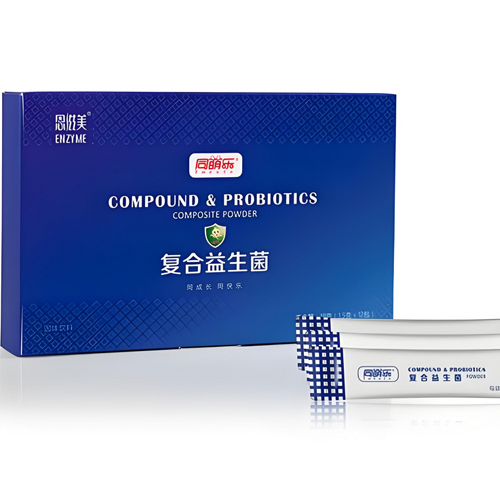
The production process of probiotic enzyme OEM is a complex and refined process, which covers multiple links from market research, formula design, raw material procurement, production and processing, quality testing, packaging and warehousing, to logistics distribution and after-sales service. Here is a detailed analysis of this process:
1、 Market research and formula design
Market Research
Before conducting OEM production of probiotic enzymes, it is necessary to conduct sufficient market research.
Understand the current demand, trends, and competition in the probiotic enzyme market, determine product positioning and target customer groups.
Analyze consumers' demand for the efficacy of probiotic enzyme products, such as promoting digestion, enhancing immunity, improving intestinal health, as well as preferences for product taste, dosage form, packaging, and other aspects.
Formula design
Based on the results of market research, collaborate with a professional R&D team to design a probiotic enzyme formula that meets market demand.
The formula should include good probiotic strains and enzyme types, as well as other auxiliary ingredients such as dietary fiber, vitamins, minerals, etc., to enhance the efficacy and nutritional value of the product.
Ensure the safety and stability of the formula, undergo rigorous testing and validation, and comply with relevant regulations and standards.
Probiotic enzyme OEM OEM factory
2、 Raw material procurement and preparation
Selection of raw material suppliers
Choosing reliable raw material suppliers is the key to ensuring the quality of probiotic enzyme products.
Assess the production capacity, quality management system, and product quality inspection reports of suppliers to ensure that they can provide raw materials that meet the requirements.
Establish long-term stable cooperative relationships with suppliers to ensure stable supply and reliable quality of raw materials.
Raw material procurement and inspection
According to the product formula and production plan, purchase the required raw materials from suppliers.
In the procurement process, it is necessary to strictly control the quality of raw materials and inspect and accept each batch of raw materials.
Ensure that the source of raw materials is legal, of qualified quality, and in compliance with relevant regulations and standards. For imported raw materials, corresponding import procedures and inspection and quarantine certificates must be obtained.
3、 Production and processing
Determination of production process
Determine the appropriate production process based on the dosage form and formula of the product.
The production process of probiotic enzymes generally includes fermentation, extraction, concentration, drying, mixing, packaging and other steps.
Optimize production process parameters to improve production efficiency and product quality.
Selection of production equipment
Choosing advanced production equipment is an important condition for ensuring product quality and production efficiency.
Select suitable fermentation equipment, extraction equipment, concentration equipment, drying equipment, mixing equipment, and packaging equipment according to the requirements of the production process.
Ensure stable performance, easy operation, simple maintenance, and compliance with relevant regulations and standards of production equipment.
process control
In the production process, it is necessary to strictly control the quality and hygiene of each link.
Monitor the entire process of raw material input, fermentation, extraction, concentration, drying, mixing, and packaging.
Establish a strict quality inspection system, conduct sampling inspections on each batch of products, and ensure that the quality of the products meets the standard requirements.
Original OEM manufacturer of probiotic enzyme OEM
4、 Quality inspection and monitoring
Raw material testing
Before the raw materials are put into storage, each batch of raw materials should be tested.
The testing items include the purity, activity, microbial indicators, heavy metal content, and other aspects of the raw materials.
Ensure that the quality of raw materials meets the requirements. For unqualified raw materials, they should be promptly returned to the supplier or processed and cannot be used for production.
Semi finished product testing
During the production process, semi-finished products are inspected.
The testing items include the activity of the fermentation broth, the purity of the extract, and the concentration of the concentrate.
Ensure that the quality of semi-finished products meets the requirements. For unqualified semi-finished products, they should be adjusted and processed in a timely manner and should not enter the next process.
Finished product testing
Before packaging the product, conduct a comprehensive inspection of the finished product.
The testing items include the appearance, taste, microbial indicators, heavy metal content, and functional ingredient content of the product.
Ensure that the quality of the product meets the standard requirements. For unqualified finished products, they must be reworked or scrapped and must not enter the market.
5、 Packaging and Storage
Package Design
According to the design requirements of the product, carry out packaging design and production.
Packaging materials should comply with relevant regulations and standards, and have good sealing, moisture resistance, light avoidance, and freshness.
Packaging design should focus on aesthetics, practicality, and convenience to enhance product competitiveness.
Packaging process control
During the packaging process, it is necessary to strictly control the quality and hygiene of the packaging.
Monitor the entire process of disinfection of packaging materials, filling, sealing, labeling and other aspects of products.
Establish a strict packaging inspection system and conduct sampling inspections on each batch of packaged products to ensure that the quality of the packaging meets the requirements.
warehouse management
Manage the storage of packaged products.
Choose a dry, ventilated, and cool warehouse, avoiding direct sunlight and humid environments.
Classify and store products, and manage them according to production date and batch.
Establish a strict inventory management system, regularly conduct inventory checks and inspections of inventory products to ensure product quality and quantity.
6、 Logistics distribution and after-sales service
Logistics delivery
Choose reliable logistics partners to ensure timely and safe delivery of products to customers.
Assess the qualifications, reputation, transportation capacity, service quality, and other aspects of logistics companies, and select a suitable logistics company.
Sign a contract with the logistics company to clarify the rights and obligations of both parties, ensuring the smooth progress of the logistics distribution process.
During the logistics distribution process, it is necessary to track and monitor the products throughout the entire process. Ensure that the product packaging is intact and the quantity is accurate to avoid damage or loss during transportation.
after-sale service
Provide pre-sales services for products, including product consultation, sample provision, etc.
Provide after-sales service for products, such as product returns and exchanges, quality complaint handling, etc.
Regularly collect and analyze customer feedback to provide a basis for product improvement and upgrades.
In summary, the production process of probiotic enzyme OEM outsourcing is a complex and delicate process that requires close coordination and strict control of each link. Only in this way can we ensure the quality and market competitiveness of the product.
Post time: 2025-04-22


